

Letters
To you, with love

Dear one,
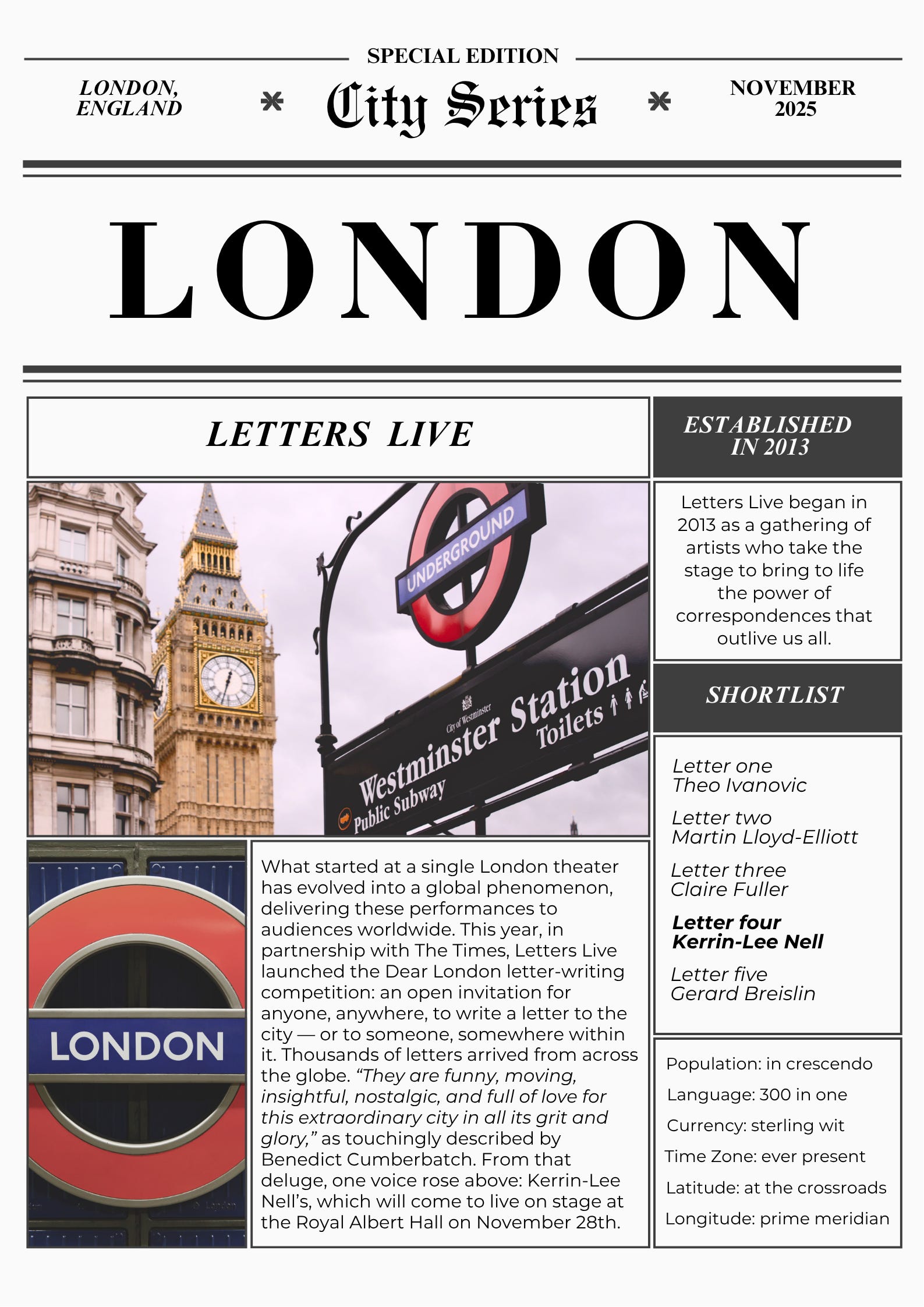
Have you heard of Letters Live? If not, go check it out. Spoiler: you might fall, at least, very much in like with it. I have, but in love.
It’s 5pm of Sunday, November 11. I was just now thinking about the art of letter exchange — a simple gesture, but so precious. Nowadays, letters might sound reminiscent of the past, and writing letters, in the send button era, can be seen as an act of resistance. But it’s not. It’s not about preservation. It is, though, about continuity. The act itself never stopped, it just changed clothes. Letters, emails, text messages, thoughtful social media posts, handwritten notes left on tables, shelves — they’re all the same impulse: composing one’s inner life and sending it toward someone, even if that someone is a future reader they’ll never meet. We write to each other because, somehow, we want to connect – we’re wired for that.
Jane Austen wrote many of them… Virginia Woolf did the same, and Hannah Arendt, Simone de Beauvoir and Sartre, Camus and Maria Casarès, Keats, Franz Kafka, Hemingway, Martha Gellhorn, Lincoln, Martin Luther King, Mandela, Maria Weston Chapman, Ignatius Sancho, and Eleanor Roosevelt voicing human rights through her tireless advocacy; as well as James Joyce, Flaubert, George Orwell, Voltaire, Vincent van Gogh and his beloved brother, Theo van Gogh, Joan Didion, Émile Zola, Gandhi, Mother Teresa, Karl Marx and Friedrich Engels, Antonio Gramsci, Dietrich Bonhoeffer, Einstein, Marie Curie, Ernie Pyle, Shen Congwen, Lu Xun, Su Shi, Yukio Mishima, Natsume Sōseki, Mutsu Munemitsu, and Kawabata registering unattainable love and the transience of beauty.
There were also the women’s rights advocate, Abigail Adams, and her husband, John Adams, a Founding Father and the second U.S. President, who today, by the way, might be in despair from watching his forty-seventh successor’s debacle — that’s factual, not partisan; followed by Paul the Apostle guiding grace and sin, and who, most likely, would tag the latter — a pseudo-politician — for wanting to impersonate God — of course, the said pseudo-politician’s own definition of God, which does not apply in heaven.
Still on important historical moments, Pêro Vaz de Caminha, Maria Leopoldina, José Bonifácio, reporting injustices and asserting nations’ sovereignty.
And because our true homeland is the language one speaks, and mine is Portuguese, and since Portuguese is the language of what we feel but cannot resolve, I must list here the choreographer of contradiction, witness to the impossibility of a unified self, the poet who multiplied himself to tell the truth, who was a consciousness fractured into… clarity perhaps? — Fernando Pessoa. And given that one’s native language is home, and mine is Brazil (although, home to me has a broader definition), I’m ending this list with my favorite Brazilians — Mário de Andrade and Fernando Sabino, who captured through letters urban loneliness with humor and impeccable narrative; and last but not least, the remarkable Dora, who after a lifetime of writing letters for others — letters for people who can’t write — finally writes one for herself, to Josué, in the redemptive Walter Salles’ film Central Station.
Each one of those figures left fragments of themselves in letters.
And so have soldiers, friends, lovers, neighbors, uncles, cousins, mothers, my mother, my father, you, and I.
The first time I held an epistolary novel, I could not put it down. That was birthdays ago… I remember how enchanted I was with the raw intimacy of stories as vivid as my own, which instantly clinched: our lives do happen in letters — not between their lines, but traced by them. That fascination for letters carried me through two decades of a life dedicated to literature, while the world spun toward the algorithmical age of data, where you are now — and where here I am, writing this letter to you.
Unknowingly we write to an unknown future reader. Kerrin-Lee Nell wrote to London, which is really writing to everyone who loves every part of this city — and to those who will come to love it. Your letter, your words, Kerrin, join centuries of voices saying: I have something to tell you. Well, I very much look forward to listening to it on the 28th.
Here’s to Kerrin-Lee Nell, and the four other finalists — Theo Ivanovic, Martin Lloyd-Elliott, Claire Fuller, and Gerard Breislin. And those whose names we don’t know, as well as everyone on Substack who wrote their Dear London letter and is sharing it here on the plataform (names below) — you are part of this too.
London, London…
You’re not just a place I’ve been. You’re a part of me now. And I’ll love you, always, for the stories you told me and the ones you dared me to write. — Kerrin-Lee Nell
The format shifts. The intention, stays.
From a heart’s poste restante,
Carla
PS: More on letters to come (brought to you by moi and João Paulo Rodrigues Vieira — stay tuned!)
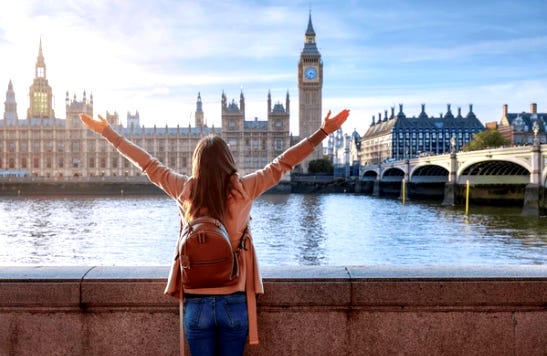
To some of our Substack writers who wrote their tribute to the city, others who answered the Letters Live call, and now have their letters live all the way from here to London, a big shout-out for showing up, writing your truth, and keeping the converstion alive.
Music excerpts:

"Vive," Djavan.
"Waterloo Sunset," The Kinks — performance by Colin Hay.
"A carta de Dora," Antonio Pinto & Orquestra Paschoal Perrotta.

*Shared for non-commercial, editorial use only.
How wonderful is this ♥️ thank you for reading, thank you for liking and thank you including my article within your own incredible words, and side-by-side so many other incredible talents!
How good is the writing community xx
Thank you for reading and sharing my letter. This is such a wonderful post :)